HIST 270 · Chapter 18 · Self-Strengthening Workshop · Teaching Page
Woren
Grand Secretary, tutor to the boy emperor, leader of the opposition
倭仁 1804–1871
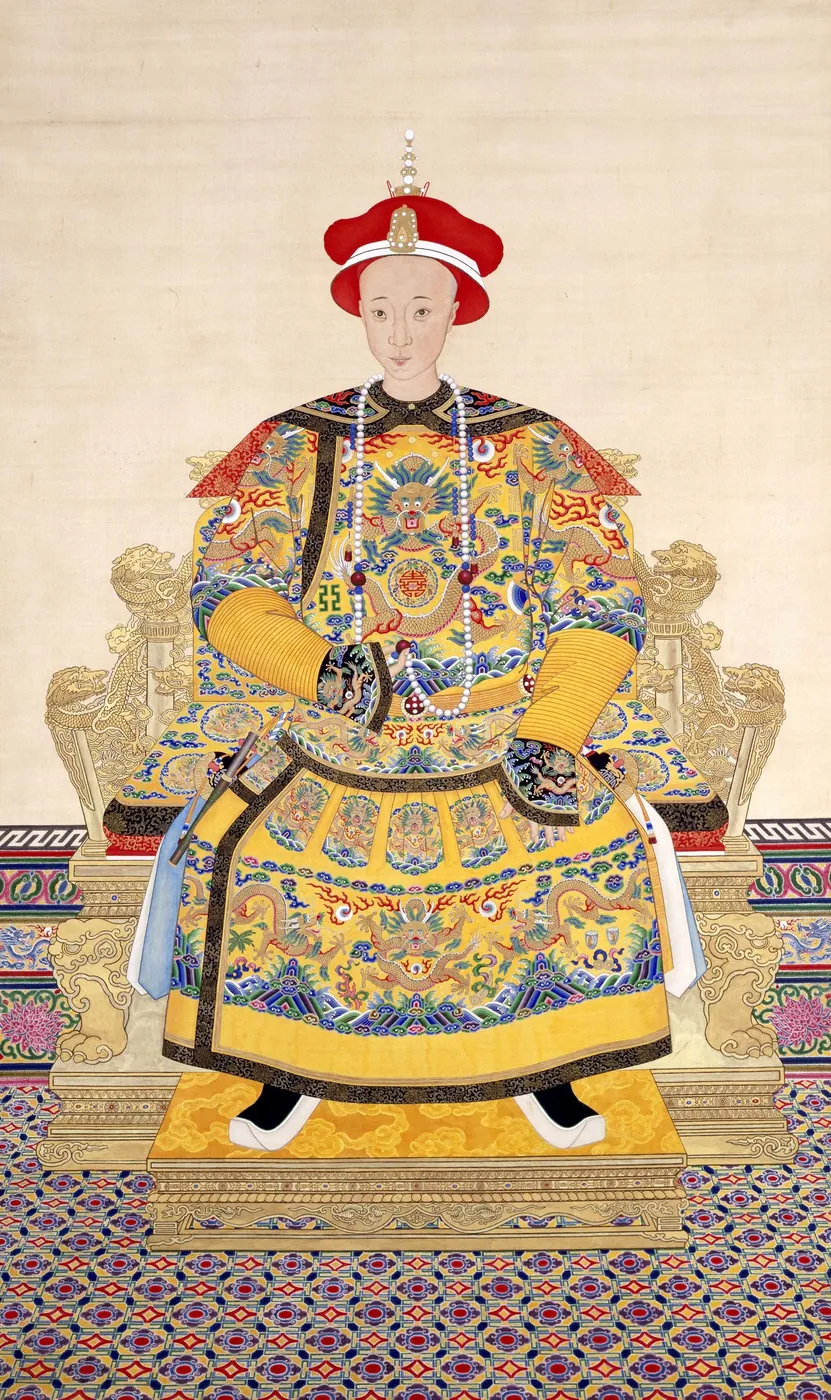
Your job today: you are the class expert on Woren. Nobody else in the room has read this page.
- Read (about 10 minutes): his story, the project or event he is tied to, and his memorial to the throne. Underline the one sentence you would most like to read aloud.
- Prepare (about 5 minutes): fill in boxes 1–5 at the bottom of this page. Short notes are fine.
- Teach (about 4 minutes): tell the class who he was and what happened, read your sentence aloud, explain why it matters, and ask your question.
- Exit ticket: answer question 6, then export your work and upload it to Canvas.
Who He Was
Woren was one of the highest-ranking men at court and the most admired teacher of Confucian morality in the empire. His family belonged to the Mongol banners, the hereditary military households that helped the Manchus conquer China. He passed the highest examination in 1829.
For decades Woren practiced a strict discipline of moral self-examination, keeping a diary of his own faults. In 1842 a young Hanlin scholar named Zeng Guofan came to him for advice, began keeping such a diary himself, and sent it to Woren for his comments. Woren believed that a state rises or falls on the character of its rulers and officials, not on its weapons.
In 1860 the foreign armies marched into the capital, the Garden of Perfect Brightness burned, and the court made peace with the men who set the fire. In 1862 Woren became a Grand Secretary and the tutor of the boy emperor, Tongzhi. When he spoke, thousands of scholars across China listened. He died on June 8, 1871.
His Event: The 1867 Fight over Mathematics in Beijing
- 1862Prince Gong's foreign office, the Zongli Yamen, opened the Tongwen Guan, a school in Beijing to train interpreters.
- 1866–1867The Zongli Yamen proposed adding a department of astronomy and mathematics, taught by Western teachers, and inviting young men who already held examination degrees to study there. The throne approved it on January 29, 1867.
- March 5, 1867A censor, Zhang Shengzao, objected. An edict brushed him aside: the plan, it said, was “simply borrowing western science in order to supplement and illustrate that already existing in China.”
- March 20, 1867Woren sent the memorial you will read below.
- April 6, 1867The Zongli Yamen replied at length. It warned that once the Grand Secretary spoke, “there will undoubtedly be a large number from among the scholars and officials who will agree with him.”
- Spring 1867The court took Woren at his word. If the empire was so full of talent, let him find Chinese mathematicians and open a school of his own. Woren replied that he could not find any. The court then appointed him to the Zongli Yamen, the foreign office he despised. He begged to be excused and was refused.
The American minister in Beijing reported home:
“The government immediately decreed that he should find such learned Chinese and set up a school of instruction. Whereupon, Wo-jin, much disturbed, said that he could not find them. The government decreed that he should enter the foreign office. This also alarmed him, and he tried to escape this new position, but was not permitted to do so. . . . This is considered by us a very skilful method of silencing the leader of the opposition.”Anson Burlingame to William Seward, May 8, 1867, Papers Relating to Foreign Affairs, 1867, pt. 1, doc. 413, pp. 482–483
But Woren won outside the room. As the Zongli Yamen had feared, many scholars agreed with him. Few good candidates applied, and the department struggled until the mathematician Li Shanlan arrived in 1868 and took charge of it in 1869. Two historians of the school conclude that “in actual fact there was no winner in the battle.” Your textbook uses Woren as its example of the conservative resistance that slowed reform (Ebrey, p. 323).
Sources: Papers Relating to Foreign Affairs, 1867, pt. 1, doc. 405, pp. 474–477 (Zongli Yamen memorial and decree of March 5), and doc. 413, pp. 482–483; Yip-Cheung Chan and Man-Keung Siu, ZDM Mathematics Education 44, no. 4 (2012): 461–472, quoting the Zongli Yamen reply of April 6, 1867, in Teng and Fairbank, China's Response to the West, Doc. 20; Hummel, “Wo-jên” and “Li Shan-lan.”
The Reading
This is Woren's memorial of March 1867, one of the most famous documents of the age. Notice that he does not say mathematics is worthless; read carefully for what he does say. He refers to himself as “your slave,” the humble form bannermen used before the throne.
Woren's Memorial to the Throne, March 20, 1867
Mathematics, one of the six arts, should indeed be learned by scholars as indicated in the Imperial decree, and it should not be considered an unworthy subject. But according to the viewpoint of your slave, astronomy and mathematics are of very little use. If these subjects are going to be taught by Westerners as regular studies, the damage will be great. . . .
Your slave has learned that the way to establish a nation is to lay emphasis on propriety and righteousness, not on power and plotting. The fundamental effort lies in the minds of people, not in techniques. Now, if we seek trifling arts and respect barbarians as teachers regardless of the possibility that the cunning barbarians may not teach us their essential techniques—even if the teachers sincerely teach and the students faithfully study them, all that can be accomplished is the training of mathematicians. From ancient down to modern times, your slave has never heard of anyone who could use mathematics to raise the nation from a state of decline or to strengthen it in time of weakness. The empire is so great that one should not worry lest there be any lack of abilities therein. If astronomy and mathematics have to be taught, an extensive search should find someone who has mastered the technique. Why is it limited to barbarians, and why is it necessary to learn from the barbarians?
Moreover, the barbarians are our enemies. In 1860 they took up arms and rebelled against us. Our capital and its suburb were invaded, our ancestral altar was shaken, our Imperial palace was burned, and our officials and people were killed or wounded. There had never been such insults during the last 200 years of our dynasty. All our scholars and officials have been stirred with heart-burning rage, and have retained their hatred until the present. Our court could not help making peace with the barbarians. How can we forget this enmity and this humiliation even for one single day?
Since the conclusion of the peace, Christianity has been prevalent and half of our ignorant people have been fooled by it. The only thing we can rely on is that our scholars should clearly explain to the people the Confucian tenets, which may be able to sustain the minds of the ignorant populace. Now if these brilliant and talented scholars, who have been trained by the nation and reserved for great future usefulness, have to change from their regular course of study to follow the barbarians, then the correct spirit will not be developed, and accordingly the evil spirit will become stronger. After several years it will end in nothing less than driving the multitudes of the Chinese people into allegiance to the barbarians. . . . Now, the empire has already been harmed by them. Should we further spread their influence and fan the flame?
Woren, memorial of March 20, 1867, trans. in Ssu-yü Teng and John K. Fairbank, eds., China's Response to the West (Cambridge, Mass.: Harvard University Press, 1954; 1979 ed.), p. 76, quoted in part in Ebrey, p. 323. Text as reproduced in Yip-Cheung Chan and Man-Keung Siu, "Facing the Change and Meeting the Challenge: Mathematics Curriculum of Tongwen Guan in China in the Second Half of the Nineteenth Century," ZDM Mathematics Education 44, no. 4 (2012): 461–472. Short classroom excerpt of a copyrighted translation.
Words to Know
Questions to Think About as You Read
- Find the sentence where Woren admits mathematics has value. Then explain what he is really against.
- Woren says the empire is so great that it must have its own experts. What happened when the court asked him to find them?
- Why does Woren connect mathematics teachers with Christianity? What is the real danger, in his eyes?
Your Work Today
Prepare to Teach Woren
Your draft saves in this browser as you type, on this device only. When you finish, click Export to .txt and upload the file to Canvas. If the download does not work, click Copy all and paste into the Canvas text box.
Exit Ticket
Answer this after everyone has taught. There is no single right answer; just give your reason.